Saturday, March 29, 2025
Friday, March 21, 2025
The remarkable sinlessness of St. Alphonsus de Liguori.
One of my very favorite saints is St. Alphonsus de Liguori. Some of my most significant moments of “conviction of sin” came from reading his Preparation for Death, for which I hope to be eternally grateful.
The below commentary is from a talk by the English prelate Henry Cardinal Manning, given in 1864 to priests of the Redemptorist Order which the saint had founded.
Mission of St. Alphonsus.
And when he is come, he will convict the world of sin, and of justice, and of judgment. John 16:8
I will therefore endeavour to trace out the perfections wrought in St. Alphonsus by the Spirit of God, to fit him for the work of convincing the world of sin.
The first and eminent grace bestowed upon him for this end was his own personal freedom from sin. They who testify against sin must needs know it; but there are two ways of knowing sin. There is the knowledge of the sinless: such as the knowledge which Jesus had of sin; of its deformity, its baseness, its deadliness, it deceitfulness; of all that sin is and does, save only the guilt, which by personal experience the sinless Son of God could not know. There is another kind of knowledge of sin, which comes by sinning. And this the world preaches as the knowledge necessary for those who would save others from sin. This was the moral theology of Satan in Paradise: ‘God doth know, that in what day soever you shall eat thereof, your eyes shall be opened, and you shall be as gods, knowing good and evil.
The farther removed from sin, the more power the servants of God have over it. The nearer to it, the more power it has over them. To be free from it, is the chief condition of convincing and of converting the world.
Now, St. Alphonsus was in a singular manner and degree preserved from sin, from his first consciousness in childhood to the end of a life of ninety years.
In the Information laid before the Holy See for the judicial process of his canonisation, it is declared, that ‘the stole of innocence which he received in baptism he returned to his Creator without a spot.’ Again, in the office which we have recited on this festival, it is declared that he had ‘a wonderful innocence of life, which he never sullied by a stain of mortal sin.’ And his confessors, after his death, declared their belief that he had never committed a deliberate venial sin. To the end of his life Alphonsus used bitterly to lament what he called his ‘great sins.’ And these were chiefly three.
First, a disrespectful word spoken to his father when he was grown to man’s estate, and already in the profession of the law, at a time of life when sons believe themselves to be free, and less dependent on a father’s will. For this fault he received from his father, before a numerous company, the chastisement of a blow. He went to his room, and spent hours kneeling in tears and prayer; and afterwards, on his knees, asked his father’s forgiveness. The second was, that for a time he fell into a comparative lukewarmness, during which he went to theatres, though, as he said, he did not remember committing there any deliberate sin. Yet these he lamented to the end of his life. Lastly, when he had failed as an advocate in some law-suit, he fell into an excess of sadness and dejection, which he traced to his self-love, and to the wound of disappointed vanity. If such sins showed prominently upon his life of ninety years, it must indeed have been white and resplendent to give them such relief.
Alphonsus, like St. Augustine, had a holy mother, to whom he traces the early horror he had for sin, and his singular preservation from it. She used to inspire him with a hatred and a fear of evil, and to take him with her to confession every week. She used to say, ’ I do not wish to be the mother of children who are condemned to eternal death.’ He testifies of himself in words of beautiful simplicity, at the end of his long and perilous life of labour and responsibility: ‘I am a Bishop, and I ought to tell the truth. I do not remember ever having told a deliberate falsehood, even when I was a child.’
From this great innocence of life sprung another perfection — his hatred of sin. This is always equal to the purity of the heart. It was this which caused such incomprehensible sorrow in the Sacred Heart of Jesus in the wilderness and in the garden. And Alphonsus, in all his instincts, abhorred the presence of evil with a supernatural hatred. He was wont to say: ‘My God, grant that I may die rather than offend Thee.’ ‘Sin is the only evil of which we need be afraid.’ ‘No sin, however slight, is a trifling evil.’ To hinder sin for a day was enough to set him in activity. When he heard of any scandal, he never delayed a moment. He would take neither food nor rest till it was corrected. Often in such times he took no food till evening. ‘Things of this sort,’ he said, ‘admit of no delays. It is an offence against God; and if there were but one single sin, we are bound to prevent it.’
HENRY EDWARD MANNING.
Bayswater, Feast of St. Alphonsus, 1864.
Source:
https://pcpbooks.org/blogs/newsletter/cardinal-manning-on-the-mission-of-st-alphonsus-liguori?
If you liked this post but you are not on my mailing list, please join the list by clicking on the below link and go to the bottom to email me. Thanks!
www.frankrega.com
Monday, March 17, 2025
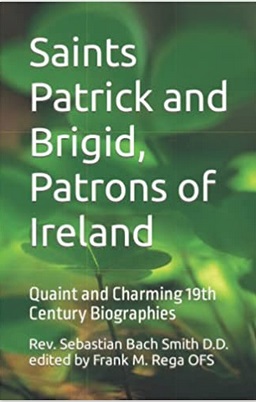
Saints Patrick and Brigid, Patrons of Ireland
(Actually I'm just the editor of this book)
Available in paperback or ebook
Click on image or Here.
Enjoy these two quaint and charming 19th century
biographies of the two most important patrons of Ireland, St.
Patrick and St. Brigid. Follow St. Patrick as he journeyed
throughout Ireland, converting the nation from the paganism of
the Druids. Learn how St. Brigid was one of the very first women
to gather consecrated virgins into convents. See their
connection with the geography of the land and its early saints,
and with each other.
If you saw this post but you are not on my mailing list, please join the list by clicking on the below link and go to the bottom to email me. Thanks!
www.frankrega.com
Friday, March 7, 2025
Why the Vatican declaration on Maria Valtorta has no binding force.
The recent document from the Dicastery for the Doctrine of the Faith (DDF), issued as a “press release,” makes the unsubstantiated claim that Maria Valtorta’s writings are simply “literary forms” used by the author, and are therefore not supernatural. However the DDF fails to provide any proof or documented facts that her works are just literature.
Further the DDF fails to provide any attempted refutation of the many proofs and documented facts that show that her works must be of supernatural origin.
Therefore the DDF press release can be described as the mere personal opinion of its author(s), since it lacks any supporting evidence. As such it has no binding force on anyone.
No human being, without divine inspiration, could have known so many facts that were presented for the very first time in The Gospel as Revealed to Me (written in the 1940’s), that have since proven to be true by scientists, geologists, Israeli archaeologists, astronomers, historians, ecologists, geographers, linguists and so on.
To dismiss off-hand in a few paragraphs the 15,000 pages written by a bed-ridden Roman Catholic victim soul is an insult to the possibly hundreds of thousands of Valtorta readers throughout the world.
This
untruthful and false official Vatican declaration and judgment that Maria's works are not supernatural and divinely inspired, but are simply literature, cannot go unchallenged. Therefore I hereby petition that this declaration be revoked.
DICASTERY FOR THE DOCTRINE OF THE FAITH
Press Release
Regarding the Writings of Maria Valtorta
The Holy See frequently receives requests from both clergy and laity for a clarification about the Church’s position on the writings of Maria Valtorta, such as her work, Il poema dell’Uomo Dio (The Poem of the Man-God), now known by the title, L’Evangelo come mi è stato rivelato (The Gospel as Revealed to Me), and other publications.
It should be reiterated that alleged “visions”, “revelations,” and “messages” contained in the writings of Maria Valtorta—or, in any case, attributed to them—cannot be regarded as having a supernatural origin. Rather, they should be considered simply as literary forms that the author used to narrate the life of Jesus Christ in her own way.
In its long tradition, the Church does not accept as normative the Apocryphal Gospels and other similar texts since it does not recognize them as divinely inspired. Instead, the Church refers back to the sure reading of the inspired Gospels.
Vatican City, 22 February 2025
============
If you saw this post but you are not on my mailing list, please join the list by clicking on the below link and go to the bottom to email me. Thanks!
www.frankrega.com
Tuesday, March 4, 2025
Vatican still gets it wrong about Maria Valtorta’s works!
In the latest statement from the Vatican, dated February 22, 2025, the Dicastery for Doctrine of the Faith declares that Maria Valtorta’s The Gospel as Revealed to Me cannot be considered of supernatural origin, but is rather is simply a literary work by the author. This is the same work that was once entitled The Poem of the Man-God.
(The statement comes from the Dicastery that also issued Fiducia Supplicans, which has been interpreted in practice as the blessing of same-sex relationships.)
At least it is a step forward compared to the Vatican’s placing The Poem of the Man-God on the now defunct Index of Forbidden Books in 1960 for being published without an Imprimatur, and describing it then as a “badly fictionalized” life of Jesus.
Thus, while it is no longer condemned and forbidden to be read, according to the Dicastery, one can now safely read it as long as it is considered a mere literary creation. A tiny step forward. But the assertion that it “cannot be considered of supernatural origin” nor of “divine inspiration” is not entirely truthful. The part that is true is that the Vatican can make those considerations and judgments. The part that is false is the assertion that her work is not of supernatural origin and of divine inspiration.
In fact The Gospel as Reveled to Me is of divine inspiration, and was willed by the Lord to be written by Maria Valtorta. I have 100% human faith upon this belief. In her other works, when she specifies that certain revelations are from the Lord, the Father, the Holy Spirit, His Blessed Mother, various saints or angels, I also accept the truth of them. I have more faith in the writings of Maria Valtorta than in the writings of Dicasteries of the Vatican.
Therefore, I encourage people to read not only The Gospel as Revealed to Me, but the three “Notebooks” and the other works written by Maria Valtorta. In fact I consider her Notebooks to be only one tiny notch of lesser importance than The Gospel as Revealed to Me.
Feb. 22, 2025. Doctrine of Faith reiterates that Valtorta's writings not supernatural but a literary production of hers. Translation below from Google.
https://www.vatican.va/roman_curia/congregations/cfaith/documents/rc_ddf_doc_20250222_comunicato-scritti-valtorta_it.html
DICASTERY FOR THE DOCTRINE OF THE FAITH Communiqué About the writings of Maria Valtorta:
The Holy See often receives requests from both clergy and lay people for clarification regarding the position of the Church regarding the writings of Maria Valtorta, such as the work Il poema dell’Uomo Dio, today known as L’Evangelo come mi è stato svelato, and other publications. In this regard, it is reiterated that alleged “visions”, “revelations” and “communications” contained in the writings of Maria Valtorta, or in any case attributed to them, cannot be considered of supernatural origin, but must be considered simply literary forms used by the Author to narrate, in her own way, the life of Jesus Christ. In its long tradition, the Church does not accept the apocryphal Gospels and other similar texts as normative, as it does not recognize their divine inspiration, referring to the safe reading of the inspired Gospels. Vatican City, February 22, 2025

